Embarking on a juicing journey can be a transformative step towards better health, but the sheer variety of juicers available often leaves aspiring enthusiasts scratching their heads. Among the most revered types are masticating juicers, known for their ability to extract nutrient-rich juice with minimal oxidation. Within this category, a critical distinction lies in their core mechanism: the auger design. Do you choose a single auger or a more robust double auger system? Understanding these differences is paramount to selecting the perfect juicer that aligns with your health goals and lifestyle. This guide will meticulously break down the mechanics, benefits, and considerations of each design, empowering you to make an informed decision for your kitchen.
Popular Juicer Types: Single vs. Double Auger
Masticating juicers, often called “slow juicers” or “cold press juicers,” operate on the principle of crushing and pressing produce slowly to extract juice. This gentle method preserves more enzymes, vitamins, and minerals compared to high-speed centrifugal juicers. The primary differentiator within masticating juicers is the number of augers—the helical screw-like component that does the work.
Single Auger Juicers
A single auger juicer, sometimes referred to as a single gear juicer, uses one powerful auger to systematically crush and squeeze fruits and vegetables against a screen. This “chewing” action efficiently separates the juice from the pulp. These juicers come in two main configurations: horizontal and vertical. Vertical models are often more popular due to their smaller footprint and gravity-assisted feeding, while horizontal models excel with leafy greens and stringy vegetables due to their design that minimizes clogging.
Pros of Single Auger Juicers:
- High Nutrient Retention: The slow speed (typically around 80 RPM) reduces heat buildup and oxidation, preserving vital nutrients and enzymes in your juice.
- Good Juice Yield: They produce a significantly higher juice yield and drier pulp compared to centrifugal juicers, making them more economical in the long run.
- Versatility: Many single auger juicers can handle a wide range of produce, from hard root vegetables to soft fruits and leafy greens. Some models even come with attachments for making nut butters, sorbets, and pasta.
- Ease of Use and Cleaning: Generally, single auger juicers are straightforward to assemble, operate, and clean, with most parts being easily rinsable.
- Quieter Operation: They operate much more quietly than centrifugal juicers, making morning juicing a less disruptive experience.
Cons of Single Auger Juicers:
- While excellent, their juice yield might be slightly less than that of twin gear juicers, especially for very fibrous greens.
- Processing certain soft fruits can sometimes be slower or require more pushing.
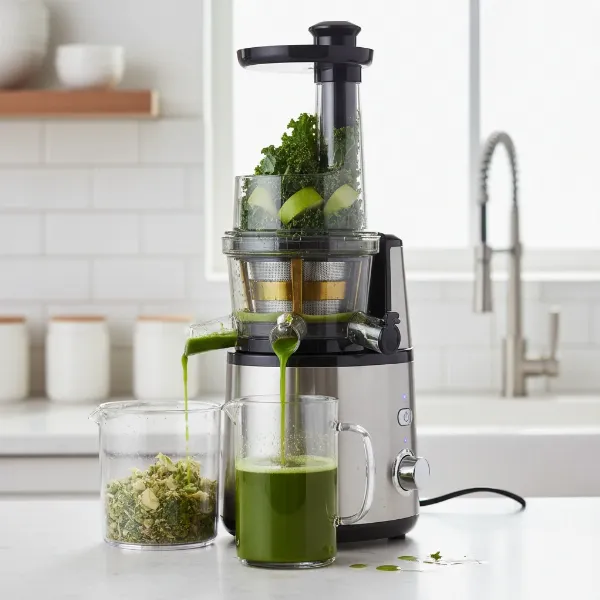 Vertical single auger juicer extracting juice from fruits and vegetables, showing pulp separation.
Double Auger (Twin Gear) Juicers
Double auger juicers, also known as twin gear or triturating juicers, feature two interlocking gears that grind and crush produce into fine particles before pressing out the juice. This two-stage process is incredibly thorough, designed for maximum extraction. The gears rotate very slowly, usually between 80-120 RPM, creating even less heat and oxidation.
Pros of Double Auger Juicers:
- Highest Juice Yield: Twin gear juicers are renowned for producing the absolute highest juice yield and the driest pulp among all juicer types, maximizing the juice extracted from your produce.
- Superior Nutrient Preservation: The meticulous crushing and pressing action, combined with extremely low oxidation, results in juice of the highest nutritional quality, which can also be stored longer—often up to 72 hours without significant nutrient degradation.
- Excellent for Leafy Greens and Wheatgrass: Their design makes them exceptionally efficient at juicing challenging fibrous ingredients like wheatgrass, kale, and spinach.
- Enhanced Versatility: Beyond juicing, many twin gear models are highly versatile, capable of making nut milks, baby food, sorbets, and extruding pasta.
Cons of Double Auger Juicers:
- Higher Cost: Twin gear juicers represent a significant investment, often being the most expensive type of juicer on the market.
- Longer Prep and Cleaning Time: Due to their more complex design with two augers and a tighter fit, they generally take longer to assemble, disassemble, and clean.
- Slower Juicing: While efficient, the juicing process itself can be slower than with a single auger, and harder produce like carrots may require more effort to feed.
When comparing, single auger juicers are often praised for their balance of performance and user-friendliness, while double auger juicers are the go-to for serious juicers prioritizing maximum yield and the purest juice quality. Both significantly outperform centrifugal juicers in terms of nutrient retention and juice quality, operating at much lower speeds to minimize heat and oxidation.
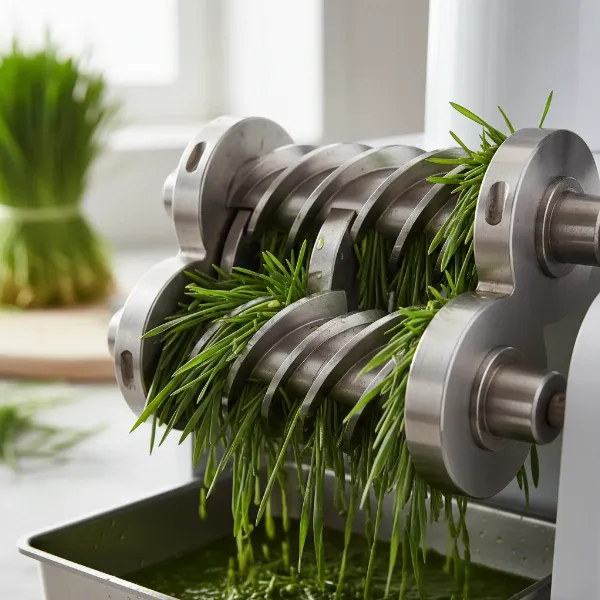 Close-up of twin gears in a double auger juicer grinding wheatgrass for high yield.
Criteria for Choosing Your Auger Juicer
Selecting the right auger juicer depends entirely on your personal juicing habits and priorities. Considering these factors will guide you toward the best choice.
Juicing Needs & Frequency
What types of produce do you plan to juice most often? If you primarily juice hard fruits and vegetables with occasional greens, a versatile single auger might suffice. However, if leafy greens, wheatgrass, and herbs are staples in your daily regimen, a double auger juicer’s superior extraction for these items could be invaluable. Consider how frequently you’ll be juicing—daily juicers might prioritize efficiency and nutrient density, while occasional users might lean towards ease of cleaning.
Yield & Nutrient Preservation
For those dedicated to maximizing every drop of juice and preserving its delicate enzymes, a double auger juicer offers the ultimate performance. Its meticulous grinding process ensures the driest pulp and the highest nutrient yield. If marginal differences in yield are less critical, a single auger still provides excellent results far surpassing centrifugal models, often with sufficient nutrient retention for most health enthusiasts.
Ease of Use & Cleaning
How much time and effort are you willing to dedicate to juicer setup and cleanup? Single auger juicers typically boast a simpler design, leading to quicker assembly and easier cleaning. Double auger juicers, with their interlocking gears and intricate parts, often demand more time and patience for thorough cleaning. This can be a significant factor for busy individuals.
Budget & Investment
Auger juicers, especially twin gear models, represent a considerable investment. While a single auger juicer offers a more accessible entry point into cold press juicing, double auger juicers, despite their higher initial cost, can offer long-term savings due to their exceptional ability to extract more juice from the same amount of produce. Evaluate your budget against the long-term value and your juicing commitment.
Countertop Space
Consider the available space in your kitchen. Vertical single auger juicers are typically more compact in footprint, though they can be taller. Horizontal single auger and double auger juicers often require more linear counter space. Think about where you plan to store your juicer and whether its dimensions fit comfortably into your kitchen layout.
Single Auger vs. Double Auger: A Comparative Table
To simplify your decision, here’s a direct comparison of key aspects between single and double auger juicers:
| Feature | Single Auger Juicer | Double Auger (Twin Gear) Juicer |
|---|---|---|
| Juice Yield | Very Good (High, drier pulp than centrifugal) | Excellent (Highest yield, driest pulp) |
| Nutrient Quality | Excellent (Minimal oxidation, good enzyme retention) | Superior (Least oxidation, maximum enzyme retention) |
| Best For | General fruits, vegetables, moderate leafy greens | All leafy greens, wheatgrass, fibrous vegetables, all produce |
| Juicing Speed | Moderate (Generally faster than double auger) | Slower (More thorough process) |
| Ease of Cleaning | Easier, fewer parts to clean | More complex, takes longer to clean |
| Cost | Mid-range to High-end | Premium, highest price point |
| Versatility | High (Nut butters, sorbets, pasta with attachments) | Very High (Often excels in versatility attachments) |
| Noise Level | Quiet | Very Quiet |
Mastering Your Auger Juicer: Usage and Care Tips
Getting the most out of your auger juicer involves understanding proper usage and committing to a consistent cleaning routine. These practices ensure longevity and optimal juice quality.
Hướng Dẫn Sử Dụng Máy Ép Đúng Cách
To maximize your juicer’s efficiency, always cut produce into manageable sizes that fit easily into the feeding chute. For single auger juicers, especially horizontal models, alternate between soft and hard produce to help push ingredients through and prevent clogging. With double auger juicers, feed items slowly and consistently to allow the gears to meticulously grind and extract. Avoid overloading the machine, and use the tamper only when necessary.
Vệ Sinh Máy Ép Sau Mỗi Lần Sử Dụng
Immediate cleaning after each use is crucial to prevent pulp from drying and hardening, which makes cleaning significantly more difficult.
- Disassemble: Carefully take apart all removable parts of your juicer.
- Rinse: Rinse all components under warm running water to remove pulp residue. Use a stiff brush, often provided with the juicer, to clean the screen and augers thoroughly.
- Wash: For a deeper clean, wash parts with mild soap and water. Some components may be dishwasher safe, but always check your manual.
- Dry: Allow all parts to air dry completely before reassembling or storing to prevent mold and mildew growth.
Mẹo Bảo Quản Máy Ép
Regular maintenance can significantly extend the lifespan of your auger juicer. Ensure that your juicer’s motor base is always kept dry and free from juice spills. Store your juicer in a clean, dry place, ideally fully disassembled and dried, or covered to protect it from dust. Periodically check for any signs of wear on the augers or screens, and replace parts as needed. Following these simple steps will ensure your juicer remains a reliable partner in your health journey for years to come.
Where to Purchase Your Next Auger Juicer
Finding the right auger juicer involves not just knowing what to look for, but also where to look. Reputable retailers offer reliability and support that are crucial for such an investment.
You can typically find auger juicers at major electronics stores, specialized kitchen appliance retailers, and large online marketplaces. Well-known brands often have their own official websites where you can purchase directly, sometimes with exclusive deals or extended warranties. It’s often beneficial to visit physical stores to see the juicers firsthand, assess their size, and get a feel for their construction.
When purchasing online, always prioritize retailers with clear return policies and robust customer service. Read product descriptions carefully, paying close attention to specifications, materials used, and included accessories. Check the warranty details, as a good warranty is a testament to the manufacturer’s confidence in their product’s durability. Comparing prices across different platforms can also help you find the best value.
Your Ultimate Auger Juicer Buying Guide
Making the final choice between a single and double auger juicer doesn’t have to be overwhelming. By systematically evaluating your needs, you can confidently invest in the ideal machine.
Start by identifying your primary juicing ingredients and frequency. Are you a daily green juice enthusiast, or do you mostly enjoy occasional fruit blends? This will heavily influence whether the superior extraction of a twin gear juicer for fibrous greens is a necessity or if a versatile single auger will suffice.
Next, consider your commitment to nutrient density and juice yield. If you’re seeking the highest possible nutrient retention and want to extract every last drop from your produce for maximum economy, a double auger is unmatched. For those with slightly less stringent requirements, a single auger offers an excellent balance.
Factor in your lifestyle regarding time and effort. If quick cleanup and straightforward operation are high priorities, a single auger will likely be a better fit. If you don’t mind a bit more time for assembly and cleaning in exchange for top-tier juice quality, a twin gear might be your match.
Finally, set a realistic budget. While double auger juicers come with a higher price tag, their efficiency can lead to savings on produce over time. A single auger provides a more budget-friendly entry point without compromising significantly on juice quality compared to other juicer types. Remember to read user reviews and watch demonstrations to see the machines in action before making your final decision.
“Choosing the right juicer is like choosing a chef’s knife – it needs to fit your hand and your culinary style. For serious juicers, the efficiency and nutrient extraction of a good auger system is non-negotiable.” – Alex Chen, Nutrition & Appliance Expert
Conclusion
The world of auger juicers offers a fantastic path to healthier living, with both single and double auger designs bringing unique strengths to the table. Single auger juicers provide an excellent all-around solution, balancing efficiency, versatility, and ease of use, making them a superb choice for most home juicers. Double auger, or twin gear, juicers, while demanding a greater investment of time and money, stand as the pinnacle for those seeking the absolute highest juice yield, unparalleled nutrient preservation, and superior performance with dense leafy greens. Ultimately, the “best” juicer is the one that fits seamlessly into your lifestyle, meets your specific health goals, and motivates you to keep juicing consistently. What kind of juicer will truly empower your health journey?
Frequently Asked Questions
What’s the main difference in juice quality between single and double auger juicers?
While both excel at preserving nutrients compared to centrifugal juicers, double auger juicers generally produce juice with even less oxidation and higher concentrations of enzymes and vitamins due to their more thorough, two-stage grinding process. This often translates to a smoother texture and a longer shelf life for the juice.
Are double auger juicers always worth the higher price?
The higher price of double auger juicers is often justified for serious juicers who prioritize maximum juice yield, superior nutrient retention, and frequent processing of leafy greens and wheatgrass. While a significant investment, the long-term savings on produce due to higher extraction rates and the enhanced nutritional benefits can make them a worthwhile choice for dedicated users.