Imagine a world where healthy desserts are not just a possibility, but a delightful reality achievable right in your kitchen. With a slow juicer, also known as a masticating juicer, you can effortlessly transform simple frozen fruits into luscious sorbets and creamy “nice cream” that rival store-bought treats, without the added sugars or artificial ingredients. This versatile kitchen appliance, renowned for its ability to extract nutrient-dense juices, also holds the secret to creating wholesome, plant-based frozen desserts that cater to every craving and dietary need. Whether you’re a seasoned juicing enthusiast or new to the world of cold-pressed goodness, preparing these refreshing delights is surprisingly straightforward, offering a fantastic way to enjoy more fruits and satisfy your sweet tooth responsibly.
Unlocking Your Slow Juicer’s Potential for Frozen Treats
Slow juicers operate with a gentle, masticating action that crushes and presses ingredients at low speeds, minimizing heat buildup and oxidation. This method is crucial not only for preserving vital nutrients and enzymes in juices but also for creating the perfect texture in frozen desserts. Unlike high-speed blenders that can whip air into ingredients, slow juicers homogenize frozen fruit into a dense, smooth, and incredibly creamy consistency, akin to soft-serve ice cream.
Many slow juicers come equipped with a special attachment for making frozen desserts, often referred to as a “blank plate” or a “homogenizing screen,” which replaces the fine mesh screen used for juicing [cite: 1 (search 1), 5 (search 1), 1 (search 3)]. This attachment allows the juicer’s auger to pulverize frozen ingredients thoroughly without separating the pulp from any liquid, ensuring a uniform, rich output. If your juicer offers a specific “sorbet attachment” or “ice cream maker,” this is the component you’ll use to embark on your frozen dessert adventure. [cite: 2 (search 1), 2 (search 2), 3 (search 2), 1 (search 3)]
Essential Ingredients for Homemade Sorbet and Ice Cream
The beauty of making sorbet and ice cream with a slow juicer lies in its simplicity and reliance on minimal, natural ingredients. The star of these recipes is undoubtedly frozen fruit.
- Frozen Fruits: Opt for ripe, sweet fruits for the best flavor. Popular choices include bananas (which yield an incredibly creamy base for “nice cream”), strawberries, mangoes, pineapples, peaches, and berries [cite: 1 (search 1), 5 (search 1), 1 (search 2), 3 (search 2)]. You can freeze fresh, ripe fruit yourself by cutting it into manageable chunks and spreading it on a baking sheet before transferring to a freezer-safe bag, or purchase pre-frozen fruit for convenience. For optimal results, ensure your fruit is thoroughly frozen for at least 8-12 hours [cite: 4 (search 2)].
- Optional Additions for Flavor and Texture:
- Natural Sweeteners: A drizzle of raw honey, maple syrup, or agave nectar can enhance sweetness, especially for less ripe fruits [cite: 4 (search 1)].
- Acids: A splash of lemon or lime juice can brighten flavors and balance sweetness, particularly in berry or tropical fruit sorbets [cite: 4 (search 1)].
- Creaminess Boosters: For “nice cream,” adding a tablespoon or two of plant-based milk (like almond or coconut milk) or a dollop of full-fat coconut cream can elevate the creaminess, though bananas often provide sufficient richness on their own.
Step-by-Step Guide to Making Sorbet with a Slow Juicer
Creating vibrant, refreshing sorbet is a simple, two-step process once your slow juicer is set up correctly.
1. Preparing Your Juicer and Fruit
|
Our Picks for the Best Juicer in 2026
As an Amazon Associate I earn from qualifying purchases.
|
||
| Num | Product | Action |
|---|---|---|
| 1 | Ninja NeverClog Cold Press Juicer, Powerful Slow Juicer with Total Pulp Control, Countertop, Electric, 2 Pulp Functions, Dishwasher Safe, 2nd Generation, Charcoal, JC151 |

|
| 2 | Cold Press Juicer Machines with 5.8\" Large Feed Chute, Juicer for Whole Vegetables & Fruits, High Juice Yield (Grey) |
|
| 3 | Hamilton Beach Juicer Machine, Big Mouth 3” Feed Chute for Whole Fruits and Vegetables, Easy to Clean, Centrifugal Extractor, Vegetable & Fruit Juicer, BPA Free, 800W Motor, Black |
|
| 4 | Juicer Machines, 5.3\" Wide Feed Chute Cold Press Juicer for Whole Vegetables & Fruits, High Juice Yield, BPA Free (Slivery) |
|
| 5 | AMZCHEF Cold Press Juicer, Juicers Machines - 5.4\" Large Feed Chute for Whole Fruits & Vegetables, Stainless Steel Slow Masticating Juice Easy to Clean, Large Auger, Triple Strainers |
|
| 6 | Juicer Machines with 5.8\" Large Feed Chute, Cold Press Juicer for Whole Vegetables and Fruits 400W, Slow Masticating juicer Easy to Clean Juice Extractor Machine High Juice Yield |
|
| 7 | Qcen Juicer Machine, 800W Centrifugal Juicer Extractor with Wide Mouth 3” Feed Chute for Fruit Vegetable, Easy to Clean, Stainless Steel, BPA-free (Black) |
|
| 8 | Ninja NeverClog Cold Press Juicer, Powerful Slow Juicer with Total Pulp Control, Countertop, Electric, 2 Pulp Functions, Dishwasher Safe, 2nd Generation, Blue/Navy, JC151NV |
|
| 9 | Qcen Juicer Machine, 500W Centrifugal Juicer Extractor with Wide Mouth 3” Feed Chute for Fruit Vegetable, Easy to Clean, Stainless Steel, BPA-free (Black) |
|
| 10 | Juicer Machines, Juilist 3\" Wide Mouth Juicer Extractor Max Power 800W, for Vegetable and Fruit with 3-Speed Setting, 400W Motor, Easy to Clean |
|
First, ensure your slow juicer is fitted with the blank plate or sorbet attachment, specifically designed for homogenizing frozen ingredients, not juicing liquids [cite: 1 (search 1), 2 (search 1), 5 (search 1)]. Place a bowl or container beneath the juicer’s spout to collect your freshly made sorbet. Next, take your frozen fruit out of the freezer. It’s crucial to let it thaw slightly for about 10-15 minutes at room temperature, or until it’s firm but gives slightly when pressed [cite: 2 (search 1), 4 (search 2)]. This slight thaw prevents strain on your juicer’s motor and ensures a smoother output. If your fruit pieces are very large, cut them into smaller, juicer-friendly sizes.
2. Processing the Frozen Fruit
With your juicer turned on, slowly feed the semi-thawed frozen fruit into the feeding chute, adding a few pieces at a time [cite: 1 (search 1), 2 (search 1), 1 (search 2)]. Do not overload the machine. Use the tamper provided with your juicer to gently guide the fruit down, especially with smaller or bouncier pieces [cite: 5 (search 1)]. The juicer’s auger will masticate the frozen fruit, extruding a smooth, soft-serve sorbet directly into your waiting bowl. You can enjoy it immediately for a soft, creamy texture or transfer it to a freezer-safe container to firm up for a scoopable consistency later [cite: 2 (search 1)].
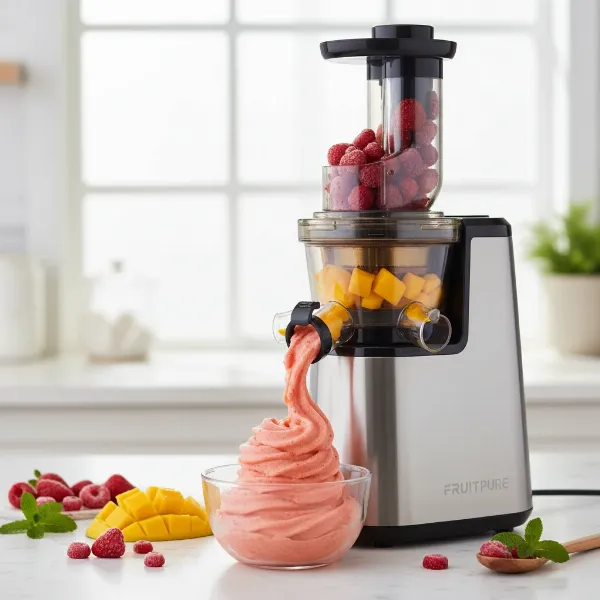 A slow juicer processing frozen fruit into smooth, vibrant sorbet, collected in a bowl below.
Transforming into Creamy “Nice Cream” (Ice Cream)
While sorbet is typically fruit-only, “nice cream” offers a creamier, more indulgent experience, often resembling traditional ice cream without dairy.
The secret to rich “nice cream” often lies in the choice of base fruit. Frozen bananas are a game-changer, providing an incredibly creamy and naturally sweet foundation that mimics the texture of soft-serve ice cream [cite: 1 (search 2), 3 (search 2)]. To make “nice cream,” follow the same preparation and processing steps as for sorbet, primarily using frozen bananas, or a blend of bananas with other frozen fruits like strawberries or cocoa powder for chocolate “nice cream.”
For an extra decadent texture, especially if you prefer a less banana-forward flavor, you can add a small amount of full-fat coconut milk or cream directly with the frozen fruit as you feed it into the juicer [cite: 5 (search 2)]. This addition enhances the richness and creates a smoother, more luxurious mouthfeel. Experiment with flavors by adding vanilla extract, a pinch of cinnamon, or even a spoonful of nut butter to the frozen fruit before processing.
Tips for Perfect Frozen Desserts Every Time
Achieving consistently delicious sorbet and “nice cream” is easy with a few expert tips.
- Optimal Fruit Temperature: The brief thawing period before juicing is critical [cite: 2 (search 1), 4 (search 2)]. If the fruit is too hard, it can strain the motor or cause the juicer to jam. If it’s too soft, the output might be more liquid than creamy. Aim for a consistency where the fruit is still very cold but slightly yielding.
- Slow and Steady Feeding: Resist the urge to rush. Feed frozen fruit into your slow juicer slowly and steadily. This allows the auger to process each piece thoroughly, resulting in a perfectly smooth texture and preventing blockages [cite: 1 (search 1)].
- Creative Flavor Combinations: Don’t be afraid to experiment! Tropical fruits like mango and pineapple pair beautifully, while berries and peaches offer refreshing options [cite: 5 (search 1)]. For “nice cream,” consider banana and peanut butter, or mango and passion fruit.
- Storage Savvy: While best enjoyed immediately, leftover sorbet or “nice cream” can be stored in an airtight, freezer-safe container for up to two months [cite: 2 (search 1)]. When ready to eat, let it thaw for 5-10 minutes at room temperature for easier scooping.
- Layering and Toppings: Elevate your dessert with delightful toppings. Fresh fruit, chopped nuts, granola, coconut flakes, or a drizzle of honey or chocolate sauce can turn a simple treat into a gourmet experience [cite: 1 (search 1), 5 (search 1), 3 (search 2)].
“The versatility of a slow juicer goes far beyond just extracting juice; it’s a game-changer for creating wholesome frozen desserts that are both delicious and incredibly nutritious. The key is in understanding how its gentle, masticating action transforms frozen fruit into pure, creamy delight.” – Alex Chen, Juicer Technology Specialist.
Choosing the Right Slow Juicer for Frozen Delights
When selecting a slow juicer primarily for making sorbets and “nice cream,” certain features can enhance your experience.
- Dedicated Attachments: Look for models that specifically include a “blank plate,” “homogenizing screen,” or a dedicated “sorbet attachment” [cite: 1 (search 3), 2 (search 3), 4 (search 3), 5 (search 3)]. Some popular brands like Nama and Kuvings are known for offering these accessories [cite: 1 (search 3), 2 (search 2)].
- Motor Power and Durability: A robust motor is beneficial for processing hard frozen fruits efficiently without overheating. While slow juicers operate at low RPMs, adequate power ensures longevity and consistent performance.
- Ease of Cleaning: As you’ll be processing dense, sticky ingredients, a juicer that is easy to disassemble and clean is a huge advantage. Many come with specialized brushes to help with this [cite: 5 (search 3)].
- Feed Chute Size: A wider feed chute can reduce prep time as it accommodates larger pieces of frozen fruit, though slower feeding is still recommended. Some juicers feature dual-chute systems for various produce types [cite: 3 (search 3)].
Maintenance: Keeping Your Juicer Ready for Desserts
Proper care ensures your slow juicer remains a reliable tool for all your culinary creations.
1. Immediate Cleaning
After enjoying your homemade sorbet or “nice cream,” it’s essential to clean your juicer promptly [cite: 1 (search 2)]. Food particles, especially from frozen fruit, can dry and harden, making them much more difficult to remove later. A quick rinse immediately after use can save significant effort.
2. Disassembly and Washing
Disassemble your juicer according to the manufacturer’s instructions. Most slow juicers have removable parts that include the auger, screen (or blank plate), pulp and juice spouts, and the hopper. Wash these components under warm running water using mild dish soap. Use the provided cleaning brush, especially for any nooks, crannies, or remaining pulp.
3. Drying and Storage
Once thoroughly cleaned, allow all parts to air dry completely before reassembling or storing. This prevents mold and mildew growth. Store your juicer in a dry, clean place, ready for your next healthy juicing session or frozen dessert creation.
“To prolong the life of your slow juicer and ensure optimal performance for all tasks, including making delicious frozen desserts, always make it a habit to clean the machine thoroughly right after each use. Prevention is always easier than cure when it comes to kitchen appliance maintenance.” – Sarah Miller, Culinary Equipment Expert.
Buying Guide: Your Path to a Frozen Treat Machine
Choosing the perfect slow juicer to whip up sorbets and ice creams involves a few key considerations to match your lifestyle and needs.
1. Identify Your Primary Needs
Consider how often you’ll be making frozen desserts and if you also plan to use the juicer regularly for traditional juicing. If frozen treats are a main priority, prioritize models with dedicated attachments or proven performance in this area.
2. Set a Realistic Budget
Slow juicers vary widely in price. Determine how much you’re willing to invest, keeping in mind that higher-end models often offer more features, better durability, and sometimes quieter operation. However, many mid-range options provide excellent value and performance for frozen desserts.
3. Compare Features and Models
Look at the specific features mentioned above, such as homogenizing attachments, motor power, and ease of cleaning. Research different brands and their reputations for quality and customer service. Read product specifications carefully to ensure the juicer meets your expectations for making frozen treats.
4. Read User Reviews
User reviews and expert assessments can provide invaluable insights into a juicer’s real-world performance, particularly for its ability to handle frozen fruits. Pay attention to comments regarding texture, ease of use, and durability when making sorbet or “nice cream.”
5. Consider Purchase Locations
Reliable retailers, both online and in brick-and-mortar stores, are good places to buy. Look for stores with transparent return policies and robust customer support. Always verify warranty information before making a purchase.
Conclusion
Embracing your slow juicer for more than just juice opens up a world of delightful, healthy possibilities, allowing you to create homemade sorbets and “nice cream” that are free from artificial additives and brimming with natural goodness. This simple process transforms frozen fruits into creamy, refreshing treats, empowering you to control the ingredients and enjoy guilt-free indulgence. With the right technique and a little creativity, your slow juicer can become your go-to appliance for satisfying sweet cravings the healthy way. So, why not unlock the full potential of your slow juicer today and revolutionize your dessert game?
Frequently Asked Questions
Can all slow juicers make sorbet and ice cream?
While many slow juicers, especially masticating types, are capable of making frozen desserts, it’s best to check if your model includes a specific blank plate or homogenizing attachment, or if one is available for purchase separately. Some older or very basic models might not have this functionality.
Do I need to add sugar to my slow juicer sorbet or “nice cream”?
No, typically you don’t. The natural sweetness of ripe, frozen fruits like bananas, mangoes, and berries is usually sufficient. However, you can add a touch of natural sweetener like honey, maple syrup, or stevia if you prefer a sweeter taste or are using less sweet fruits.
What are the best fruits to use for “nice cream” with a slow juicer?
Frozen bananas are widely considered the best base for creamy “nice cream” due to their naturally smooth texture when processed. They can be combined with other fruits like strawberries, blueberries, or cocoa powder for varied flavors.
Can I use fresh fruit instead of frozen fruit?
No, using fresh fruit will yield juice, not sorbet or ice cream. The fruit must be frozen solid (and then slightly thawed for a few minutes) for the slow juicer to homogenize it into a creamy, dense frozen dessert consistency.
How long does homemade sorbet or “nice cream” last in the freezer?
When stored in an airtight, freezer-safe container, homemade sorbet and “nice cream” can last for up to two months. However, the texture is often best within the first few weeks. Always let it thaw briefly before serving for optimal consistency.
Is cleaning difficult after making frozen desserts?
Cleaning is generally straightforward if done immediately after use. Disassemble the juicer parts and rinse them under warm water. Any provided cleaning brushes are particularly helpful for removing sticky fruit residue from the auger and blank plate.
What is the difference between sorbet and “nice cream” made in a slow juicer?
Sorbet typically uses only frozen fruit and sometimes a little liquid or sweetener, resulting in a dairy-free, refreshing treat. “Nice cream,” while also dairy-free, usually relies on a frozen banana base to achieve a creamier texture more akin to traditional ice cream.